
International link building has become a crucial strategic lever for brands aiming to expand beyond their domestic market. However, it is often approached too mechanically, with strategies simply replicated from one country to another. Yet, as soon as you leave your home market, the rules change: SEO practices, publisher maturity, cultural expectations, and Google’s tolerance levels vary greatly.
This observation was at the heart of our latest Stiv’Up webinar, entirely dedicated to international link building. Indeed, it is a topic we care deeply about at Stiv Media, as the vast majority of our clients operate across Europe and even globally! Here’s a snapshot of the insights we’ve gathered over the past 10 years dedicated to this type of project.
Not everyone sees link building the same way
The first mistake is believing that link building is a universal discipline with identical rules regardless of the target country. In reality, each market has its own SEO culture and level of maturity.
In France, link building is widely practiced and fairly well accepted. Media outlets are often open to partnerships, and the ecosystem is well structured. In contrast, Germany stands out with a very high demand for credibility and editorial quality. Publishers there are less receptive to disguised sponsorship approaches, and artificial signals are closely monitored.
Spain has long been marked by aggressive keyword practices, though recent Google updates have curbed these significantly. The UK, on the other hand, is a highly competitive market where content quality is paramount and even minor issues can become penalizing.
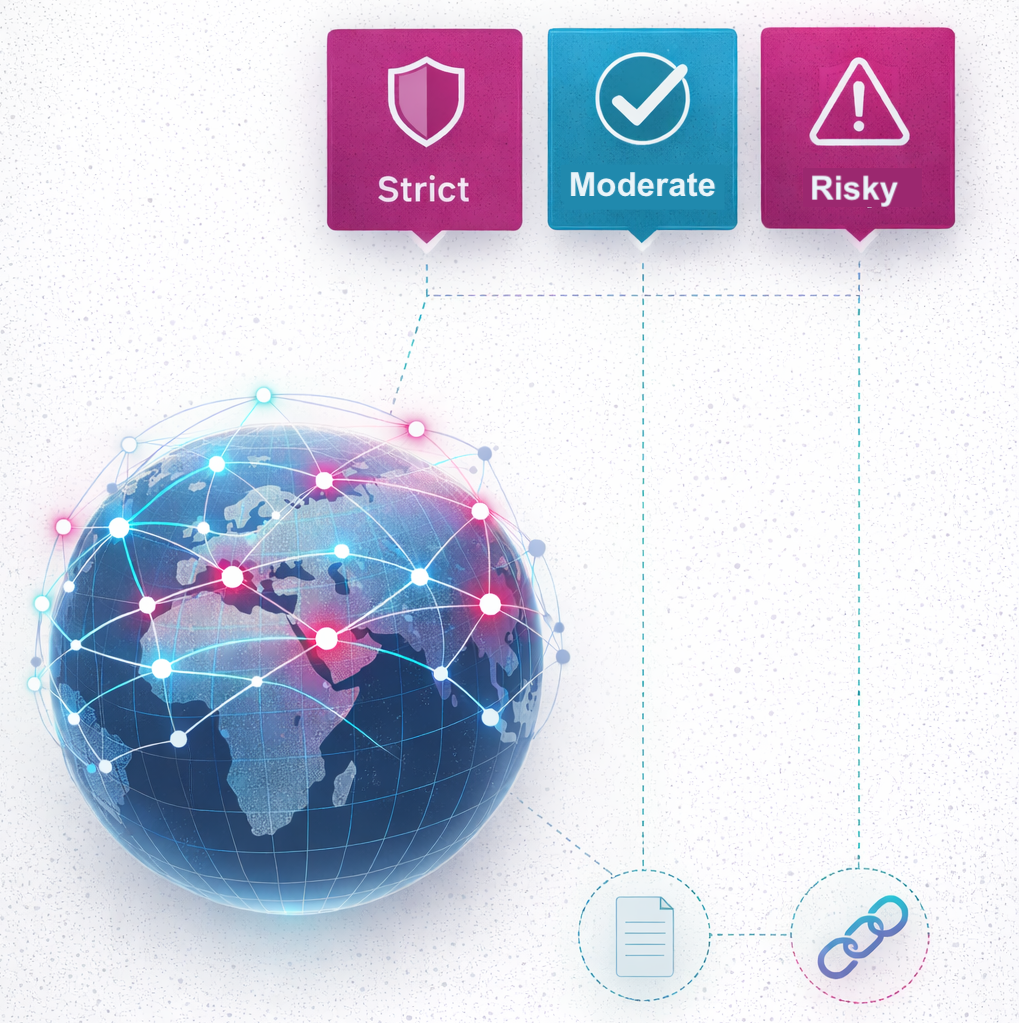
Finally, some markets like the US or Scandinavian countries are among the strictest globally. Conversely, regions such as Eastern Europe, Latin America, or parts of Asia may seem more permissive but often present riskier link profiles.
In summary:
- France: widely practiced and accepted, with media often open to partnerships.
- Germany: strong credibility and quality culture (“Deutsche Qualität”). Less tolerant of disguised sponsorship and highly vigilant of artificial signals.
- Spain: historically aggressive with keyword manipulation, though curbed by recent Google updates.
- UK: ultra-competitive, demanding high content quality and natural link profiles.
- US & Scandinavia: among the strictest, with high scrutiny of artificial practices.
👉 Conclusion: A strategy effective in one country can be risky or ineffective in another.
Link sources vary significantly by country
When tackling international link building, the availability of link sources is a central question. The supply is neither homogeneous nor equivalent across countries—be it in terms of volume, media type, or commercial accessibility.
Some markets have numerous premium media but at high prices and with strong editorial demands. Others offer more thematic blogs or mid-tier media with varying visibility. SEO metrics like Domain Rating or Authority Score aren’t enough to assess the true value of a link opportunity—they must always be considered in the local context.
It’s also key to understand that link costs can vary widely between countries without necessarily reflecting performance differences. An effective strategy depends less on comparing raw prices than on deeply understanding the media ecosystem in each target market.
👉 Smart move: Focus on real opportunities rather than just metrics.
Some key insights:
- The balance between general media, local media, and thematic blogs varies significantly by market.
Example: Over 50% of Spain’s offerings are local general media. - Average prices can be 2 to 3 times higher in some countries.
Example: Germany’s average rate is 2.4x higher than France’s.
The importance of cultural and editorial specifics
Beyond SEO concerns, international link building is also a matter of culture. Some countries require explicit sponsored mentions, while others categorically reject certain topics due to legal, ethical, or brand image reasons.
In the US, for example, media packages are often built with full-scale marketing in mind—comprehensive but typically unaffordable for SEO-only budgets. Ignoring these cultural nuances often leads to late-stage rejections, even after content is approved.
Some key differences include:
- Mandatory labels like sponsored or advertorial in some countries.
- Topics entirely banned depending on region (loans, alcohol, cheating, fur, etc.).
- Highly commercial approach in the US, often incompatible with typical SEO budgets.
👉 Common mistake: Overlooking these cultural constraints and facing irreversible setbacks.
Common mistakes in international link building
Several recurring mistakes plague international link building strategies. For instance, backlinks from US university sites are often overrated, despite being potentially artificial or irrelevant. Also, orphan pages are a major issue in some markets—such as Spain—where a publication may never appear on the homepage.
Other invisible yet impactful technical issues include: noindex categories, inconsistent site architecture, or pages only reachable through secondary menus or widgets. These issues often arise on large international media where commercial teams may lack SEO awareness.
To summarize frequent mistakes:
- US university links: often overrated, sometimes manipulative or artificial.
- Orphan pages: notably in Spain, where some publications don’t appear on the homepage.
- Invisible technical issues: noindex categories, inconsistent architecture, inaccessible pages.
These challenges are particularly common on major international media platforms or opaque media networks.
👉 Golden rule: Always verify pages technically before AND after publication.
Content formats and anchor texts: deceptive uniformity
On the surface, content formats used in link building look similar across countries: main headline, intro, sub-sections, and naturally placed links.
The same goes for anchor texts, which are not significantly more restricted internationally than in France. However, this uniformity can be misleading. Content that is technically compliant can still fall short if it doesn’t match the editorial tone and style expected by local audiences.
Native writing, translation, or enhanced writing?
Publishing in the destination site’s native language is obvious, yet still overlooked at times. A translated content—even well done—will never have the same impact as one natively written.
Thanks to the rise of AI, it’s now possible to produce high-quality content in languages you don’t master—provided a rigorous approach is taken. One effective method is to analyze local SERPs to align content with Google and user expectations.
The real challenge isn’t AI per se, but using it as a writing enhancement tool, not a mass content generator.
👉 Key point: The issue is not AI, but blind automation without human expertise.
Essential alignment between hreflang and backlinks
In international SEO, alignment between hreflang tags and backlinks is fundamental. Hreflangs tell Google which language version to show, while backlinks indicate which version deserves to rank.
If these two signals conflict, Google often favors what it sees in backlinks over what hreflang declares. Hreflang without local links is just a theoretical hint with no real proof. Some globally dominant niches may be exceptions—but they are rare.
Site structure and link strategy
The architecture of a multilingual site directly affects link building strategy. The more segmented the structure, the stronger the local proof Google expects.
Country-specific domains (ccTLDs) send strong geo-signals but require rebuilding authority for each site. Subdomains are easier technically but inherit limited authority. Subfolders allow maximum signal sharing—provided local content and links are aligned.
There is no one-size-fits-all solution. The right choice depends on goals, budget, technical constraints, and local ambitions.
| Architecture | Link Signal Sharing | Need for Local Links | Scalability |
| ccTLD | ❌ Low | ⭐⭐⭐⭐⭐ | ❌ |
| Subdomain | ⚠️ Medium | ⭐⭐⭐⭐ | ⚠️ |
| Subfolder | ✅ High | ⭐⭐ to ⭐⭐⭐ | ✅ |
Google, compliance, and risk management
Even though Google’s guidelines are global, their enforcement varies greatly across markets. What may go unnoticed in one country may raise red flags in another, depending on SEO maturity.
Strict markets require constant vigilance, while more permissive areas need tighter quality control on links.
In short:
- Strict markets: US, Germany, UK, Scandinavia
- Moderate tolerance: France, Spain, Italy, Benelux
- More permissive zones: Eastern Europe, Latin America, parts of Asia (often with high-risk toxic link profiles)
⚠️ In all cases, a local penalty can affect your entire international strategy.
As you can see, international link building requires a tailored approach, deep local market understanding, and constant adaptability. Copy-pasting a strategy from one country to another is the most costly mistake.
Testing, analyzing, adjusting, and respecting local balances are the only ways to build a successful, sustainable global link strategy. This work takes time—a lot of time—to do thoroughly and carefully.
That’s why we’re here. With 10 years of passion-fueled expertise, Stiv Media helps ambitious brands build custom international link building strategies designed for long-term performance in every market, respecting each market’s codes, constraints, and opportunities.
Whether you’re planning your first international expansion or optimizing an existing strategy, we help turn your backlinks into true growth levers—with method, coherence, and precision.
Convinced? Contact us and craft the best strategy for your projects:
